Search "trucking dispatch software" and most of what comes up is built for fleets with a dedicated IT person, a dispatch department, and enough volume to justify a five-figure annual contract. If you're running 1 to 15 trucks and you're also the dispatcher, that software is the wrong shape for your business — not because it's bad, but because it's solving a different problem than yours.
Here's what actually matters when you're evaluating dispatch software as a small carrier, and what you can safely ignore.
It has to work from a phone, for real
Your drivers aren't sitting at a desk. If the "driver app" is actually a desktop-first web portal that's awkward on mobile, or worse, requires a separate app-store install and a device the driver has to be handed, you've added friction exactly where you can't afford it. The driver-facing side should work in a phone's browser with no setup beyond logging in — assignments, status updates, and proof of delivery, all from where the driver already is.
Pricing shouldn't punish you for growing one truck at a time
A lot of trucking software is priced and packaged around fleets that are already large — per-truck add-ons stacked on top of a base platform fee, features locked behind an "enterprise" tier you won't qualify for at your size. When you're deciding whether to add a fourth or fifth truck, the software cost shouldn't be part of that math in a way that makes growth feel expensive. Look for flat, predictable plan tiers instead of a pricing page that requires a sales call to understand.
The core loop matters more than the feature count
Every dispatch tool will show you a long feature list. What actually determines whether you use it six months from now is whether the daily loop is fast: create a load, assign a driver and truck, watch it move through pending → assigned → in transit → delivered, and see whether it got paid. If that loop takes more clicks than writing it on a whiteboard, you'll drift back to the whiteboard.
- —A dispatch board you can actually see your whole day on, not one that requires scrolling through a list
- —Assignment that stops you from accidentally double-booking a driver or truck across two loads
- —A reference number on every load so a phone call with a customer or driver doesn't start with "which one do you mean"
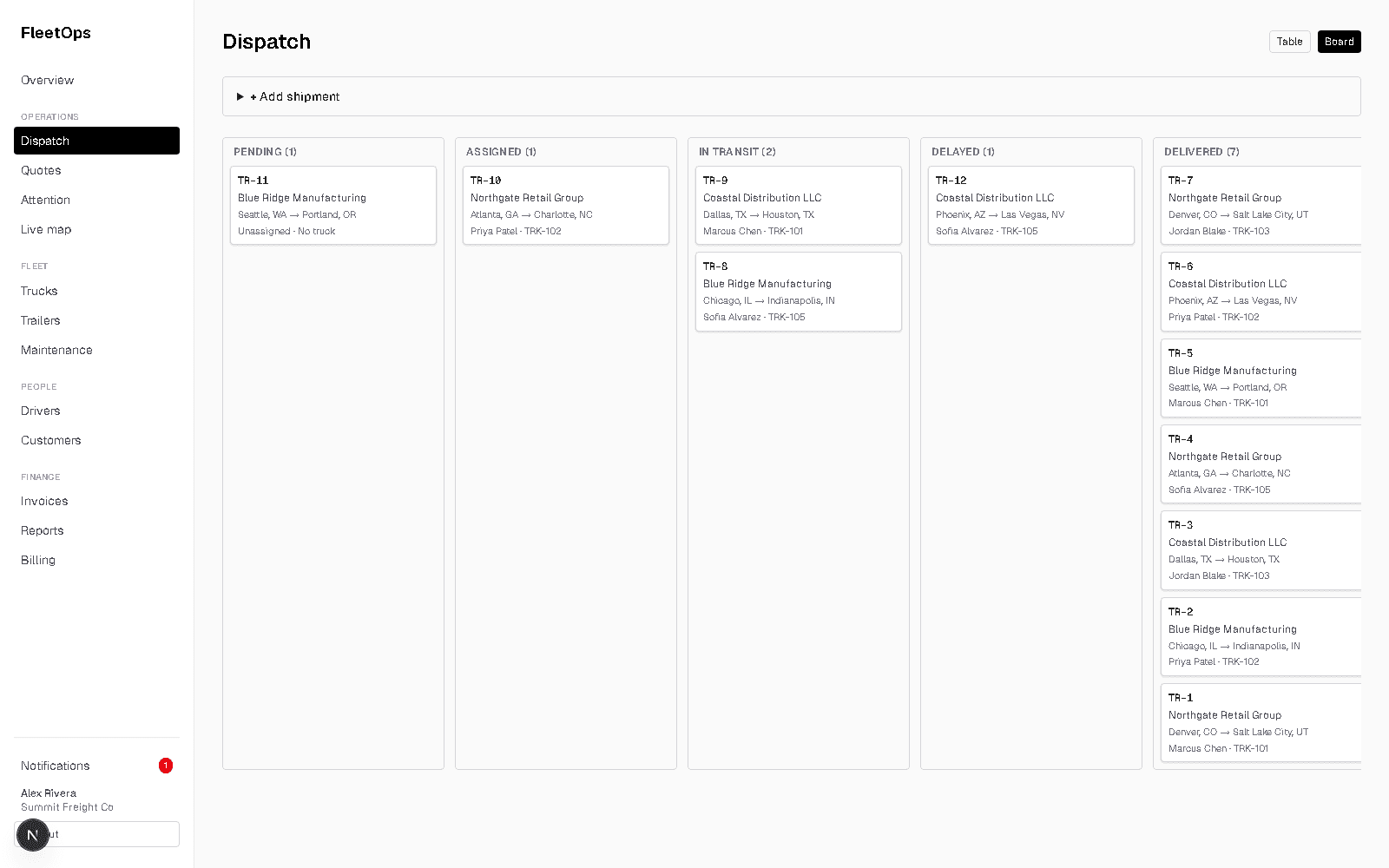
The dispatch board — every load's status at a glance, updated in a click.
You need billing in the same place as dispatch, not a separate tool
If pricing a load, dispatching it, and invoicing for it live in three different systems, you will eventually lose track of which loads actually got billed and which ones are still sitting unpaid. For a small carrier, the value of software isn't just tracking trucks — it's having one place where a load's rate, its delivery status, and its invoice status all agree with each other.
What you can safely ignore, for now
EDI integrations with major shippers, multi-warehouse load optimization, and complex role-permission hierarchies are built for fleets with dedicated staff to configure and maintain them. At 1 to 15 trucks, you don't need a system that's more complex to administer than your actual business — you need the core loop to be fast, and the option to add real ELD integration (Samsara, Motive) when you're ready, not before.
Where Haulstats fits
Haulstats was built around that core loop specifically for owner-operators and small carriers — dispatch, a phone-based driver app, maintenance, and billing in one place, with the same features available on every plan tier instead of held back for a higher one. See the full breakdown on Features or what it costs on Pricing.