You already did the hard part — the load moved, the truck and driver got paid in time and fuel, and the delivery happened. The gap between that moment and the money actually landing in your account is where a lot of small carriers quietly bleed cash flow, not because customers refuse to pay, but because the invoicing process itself adds days or weeks that didn't need to happen.
Invoice the moment a delivery is confirmed, not at month end
Batching invoices to send once a week or once a month feels efficient, but every batched invoice is a delivery that already happened days ago and is only now starting its payment-terms clock. If a customer's terms are net 30, and you wait five days to invoice, you've turned net 30 into net 35 for no reason. The fix is procedural, not clever: generate the invoice the same day the delivery is confirmed, every time, without exception.
Put payment terms in writing before the load, not after
Payment terms should be agreed with a customer once, upfront, and then applied automatically to every invoice after that — not renegotiated or clarified load by load. If a customer's actual payment behavior doesn't match the terms you agreed to, that's a signal to revisit the relationship, not just write it off as normal.
Attach proof of delivery to every invoice
A signed proof of delivery — receiver name, signature, and ideally a photo — removes the single most common excuse for a delayed payment: a customer's accounts-payable team asking for confirmation the delivery actually happened before they'll process anything. If that proof is already attached when the invoice arrives, there's nothing left for them to ask for.
Don't let a delivered load sit un-invoiced
This sounds obvious, but it's the single most common gap in a small operation: a load gets marked delivered, everyone moves on to the next one, and the invoice quietly never gets generated. Make delivered-but-not-invoiced a thing you can see at a glance, not something you have to remember to check for.
Follow up on a schedule, not a feeling
Waiting until an invoice feels "really late" before following up means you're already well past the point where a polite nudge would've worked. Pick a fixed cadence — a reminder a few days before the due date, and a follow-up shortly after it passes — and apply it to every invoice the same way. Consistency reads as professional; chasing payments only when you're personally worried about cash flow reads as disorganized, and customers notice the difference.
Track days-to-pay per customer
Some customers will consistently pay in 15 days on net-30 terms. Others will consistently stretch to 45 or 50. If you're not tracking this per customer, you won't notice the pattern until it's already affected a month's cash flow. Once you see it, you have real options — tighter terms, a deposit requirement, or simply factoring that customer's freight in less urgently next time a load comes up.
- —Which customers are chronically slow, regardless of what their stated terms say
- —Whether your average days-to-pay is trending up over the last few months
- —How much is currently outstanding, broken down by how overdue it is
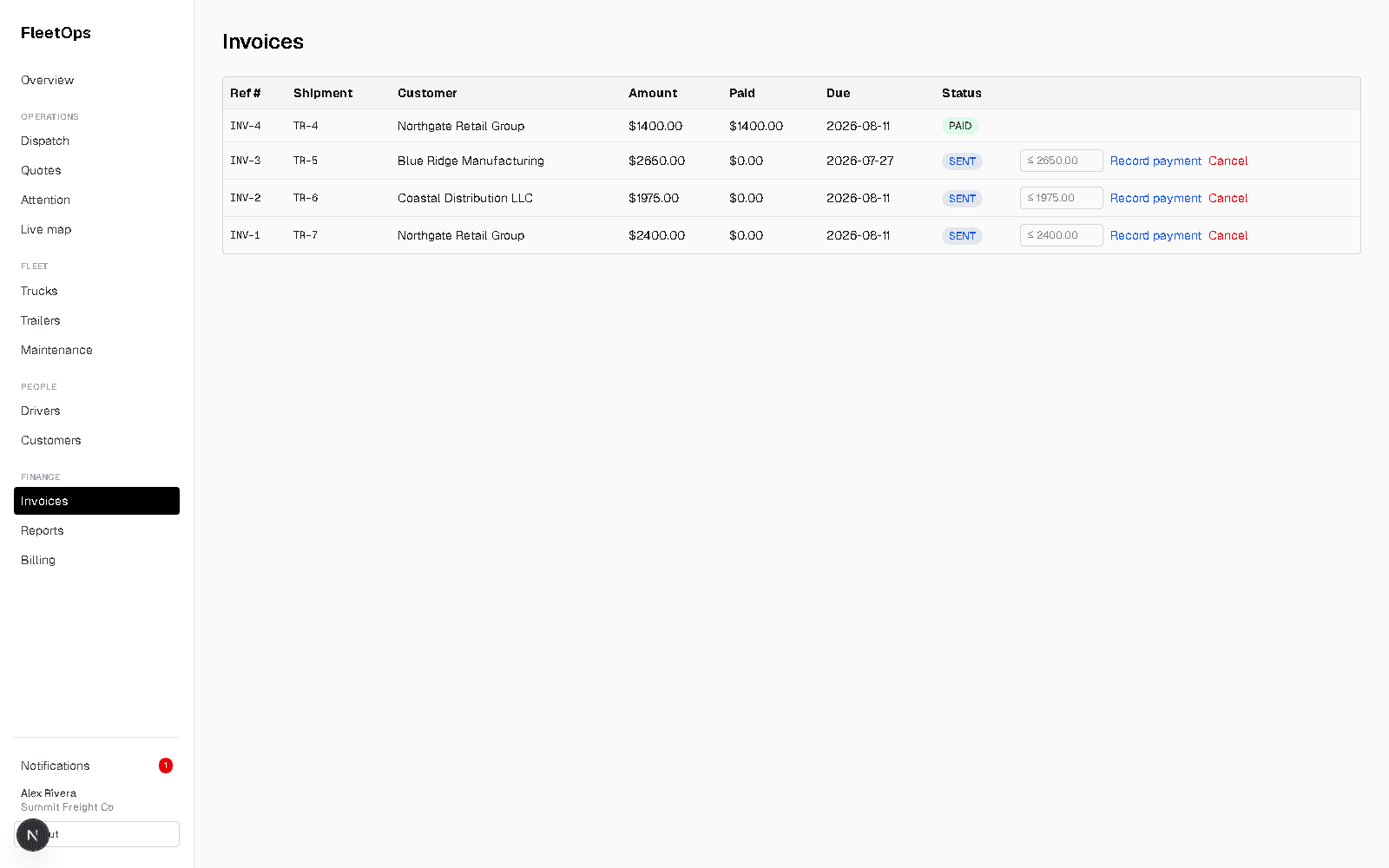
Every invoice generated from a delivered load, tracked from sent to paid in one list.
Where Haulstats fits
An invoice generates directly from a shipment's existing rate and delivery record — no re-entering data, and no separate "send" step to forget. The due date is calculated automatically from the customer's payment terms, and payments get recorded against the invoice as they come in, so "what's actually outstanding right now" is always a current answer, not a monthly reconciliation project. Details in the invoicing guide.