A load delivers on Tuesday. The driver gets a signature on a paper ticket, folds it into the door pocket, and keeps driving. You don't see that ticket — and can't invoice the customer or the broker — until the driver gets back to the yard, or remembers to text you a photo of it. That's two, sometimes three days of real money sitting completely still, for a load that already delivered.
Proof of delivery is the one piece of paperwork that directly gates getting paid, and it's also the piece most small carriers still handle the least reliably.
The "text me a photo" workaround is still broken
Most small fleets have already patched around the paper-ticket problem with a text message: driver snaps a photo of the signed BOL, sends it to the dispatcher. It's better than nothing, but it doesn't actually solve the problem — it just moves where the friction happens.
- —A photo in a text thread isn't tied to the shipment record. Someone has to manually match it to the right load, days later, when three other drivers have also texted photos that day.
- —There's no reliable timestamp a broker or customer will accept if a delivery-time dispute comes up.
- —If the goods arrived damaged, a photo of a signed paper ticket doesn't show that — you need a separate photo of the actual freight, which usually just doesn't happen.
What real electronic proof of delivery needs to do
Electronic proof of delivery isn't just "a signature on a phone instead of paper." To actually remove the delay, it has to happen inside the same system that already knows which shipment it belongs to:
- —The receiver signs directly on the driver's own phone — no separate device, no printed ticket to lose.
- —The driver can attach a photo of the delivered freight in the same step, from the phone's own camera — real protection if a damage claim shows up later.
- —It attaches automatically to the correct shipment the moment it's submitted, timestamped, with nothing for a dispatcher to manually match up afterward.
- —It's visible to the whole team immediately — not sitting unread in a phone that's already three states down the road.
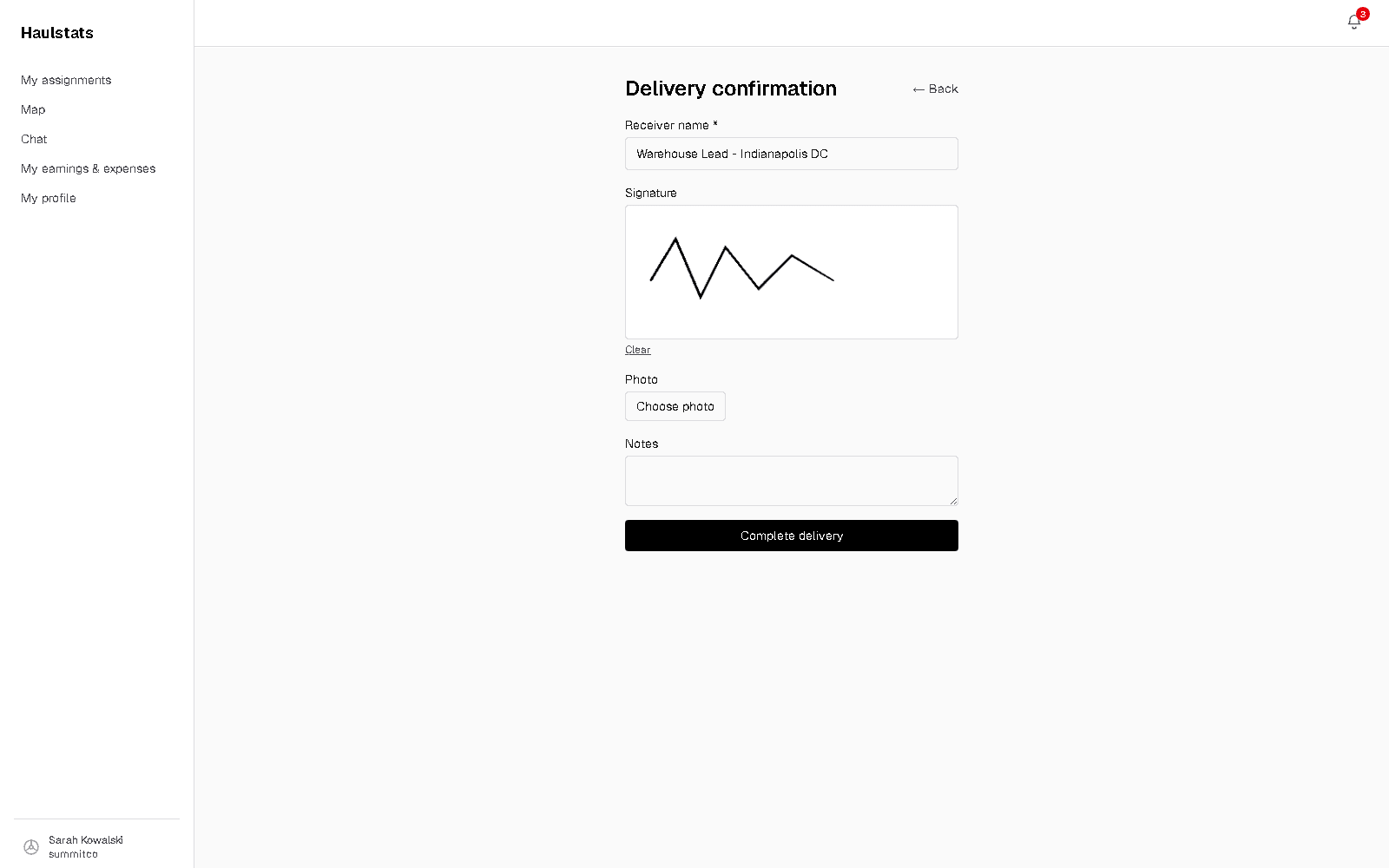
The driver-side delivery confirmation screen — receiver name, signature, and an optional photo, all in one step.
What changes the moment it's submitted
The real payoff isn't the signature itself — it's what becomes possible the second it's captured. The shipment can move to delivered the same day it actually delivers, instead of whenever a driver gets back to base. An invoice can go out same-day instead of after a multi-day paperwork lag. And if a customer disputes what showed up, there's a timestamped photo already attached to the load, not a memory of a text message from three days ago.
For more on tightening the gap between delivery and getting paid, see how to get paid faster.