A breakdown on the road costs more than the repair. There's the tow, the missed delivery window, the customer who now wonders if they should've booked someone else, and the driver sitting idle instead of earning. Almost all of that is avoidable, because almost every roadside breakdown started as a small, cheap-to-fix problem that got caught too late — or not caught at all. A preventive schedule doesn't need to be complicated to fix that; it needs to actually happen.
Build the schedule around three signals, not one
A single reminder system misses things. You need three working together:
- —Date-based — insurance renewal, registration renewal, annual DOT inspection. These happen on a calendar regardless of how many miles the truck ran.
- —Mileage-based — oil changes, tire rotation, brake inspection. A truck that runs hard for a month can hit these thresholds well before the calendar would suggest.
- —Inspection-triggered— whatever a driver's pre-trip or post-trip check actually flags that day. This is the one that catches the thing you didn't schedule for.
Relying on only the first two means you're blind between scheduled services. Relying on only the third means you're always reacting. You need all three.
The daily layer: pre-trip and post-trip inspections
This is the cheapest, highest-leverage part of the whole schedule, and it's the one most likely to get skipped under time pressure. A quick check of brakes, tires, lights, and steering before and after a trip is what actually catches a developing problem while it's still a $200 fix instead of a $2,000 one. See our DVIR explainer for what a proper inspection should cover.
The interval layer: what to schedule and roughly when
Exact intervals depend on your specific engine, manufacturer guidance, and duty cycle — always defer to what your truck's manufacturer recommends over a generic number. As a general starting point for planning purposes:
- —Oil and filter changes — commonly every 15,000–25,000 miles for a modern diesel engine on synthetic oil, though older engines or harder duty cycles may need it sooner.
- —Tire inspection and rotation — check tread depth and pressure regularly, and inspect for uneven wear that might point to an alignment issue before it wears out a set of tires early.
- —Brake inspection— on a fixed schedule regardless of whether anything seems wrong, since brake wear isn't always obvious from the driver's seat.
- —Belts, hoses, and fluid levels — cheap to check, expensive to ignore.
The compliance layer
Annual DOT inspection, insurance renewal, and registration renewal all have hard deadlines with real consequences for missing them — a truck that's out of compliance can't legally run, which is a far more expensive outcome than the renewal itself. These belong on the same calendar as everything else, not tracked separately in someone's memory.
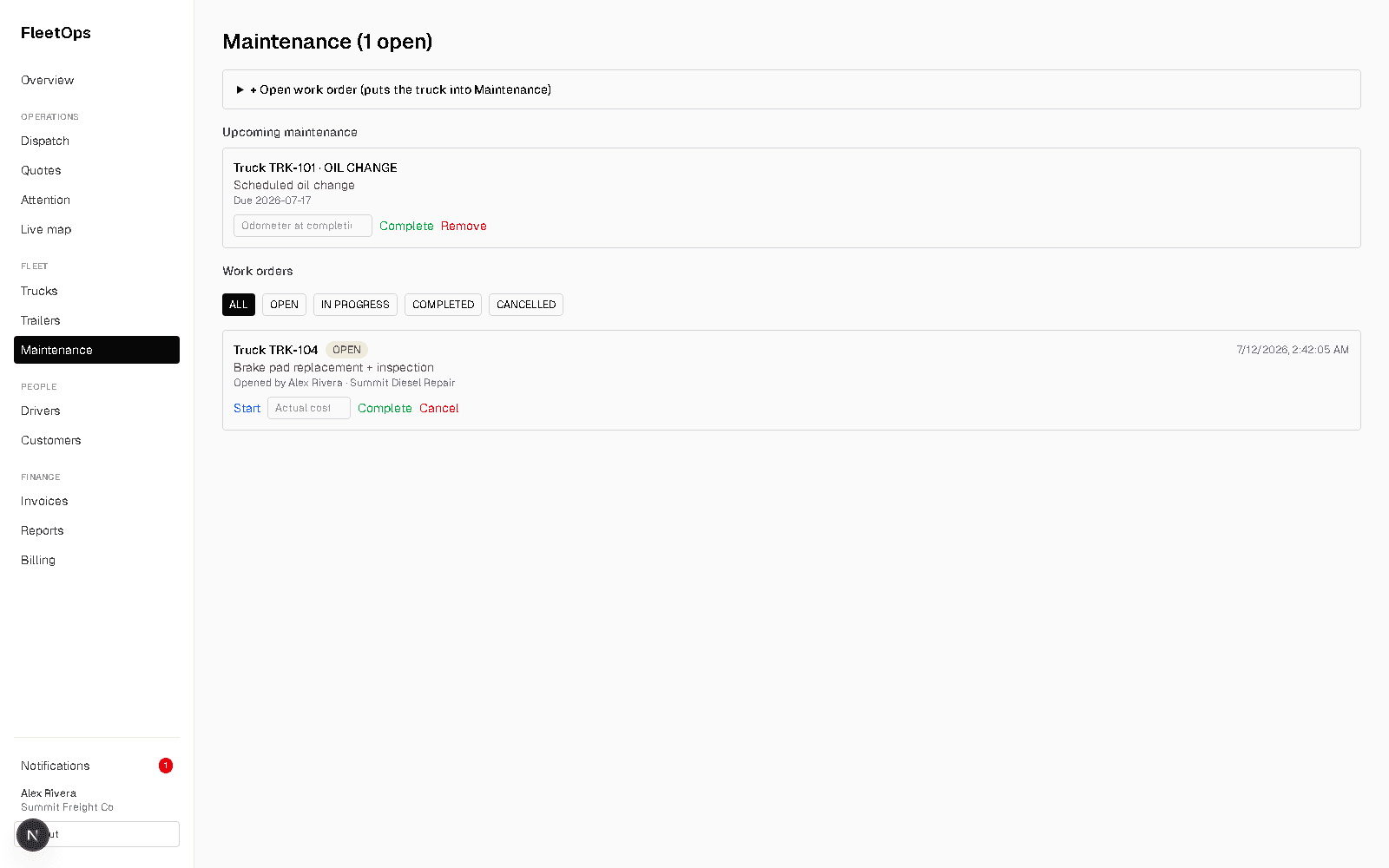
Maintenance tasks by due date or due odometer, with work orders opened automatically from a failed inspection.
Make it a system, not a memory test
The schedule only works if something actually reminds you before a deadline arrives, and if "current odometer" doesn't require someone walking out to check it manually every time a mileage-based task needs evaluating. Haulstats lets you schedule a maintenance task by due date, due odometer, or both, and derives current odometer automatically from a truck's latest inspection or fuel log — reminders go out to every admin once, a set number of days before it's due. A high-severity defect flagged on a driver's inspection also opens a work order and takes the truck out of service automatically, so a critical issue can't get missed between the daily inspection and someone actually acting on it. Full walkthrough in the maintenance guide.